

‘Atlasing’ in Bucks County - The Best Kind of Scavenger Hunt
Author: Barbara Stollsteimer
Pics & Maps provided by her from PA Atlas websites
With this article, I intend to give you all the information and incentive you need to improve your experience of birding and contribute to this worthy endeavour. Answers to any questions you are left with can be found in the PA Bird Atlas Volunteer Handbook or can be emailed to Erich Boenzli or me (Barb Stollsteimer) at PBA3.Bucks@gmail.com.
The Pennsylvania Bird Atlas is a five year project in concert with the Pennsylvania Society for Ornithology (PSO), Hawk Mountain, and the Pennsylvania Game Commission. It is the third iteration of this project and the first atlas to incorporate winter residents as well as breeding birds. The information gathered in these atlases is important for tracking bird populations over time. There are priority species that are receiving special attention so that their conservation status can be monitored.
The entire state is broken down into approximately 3x3 mile blocks.
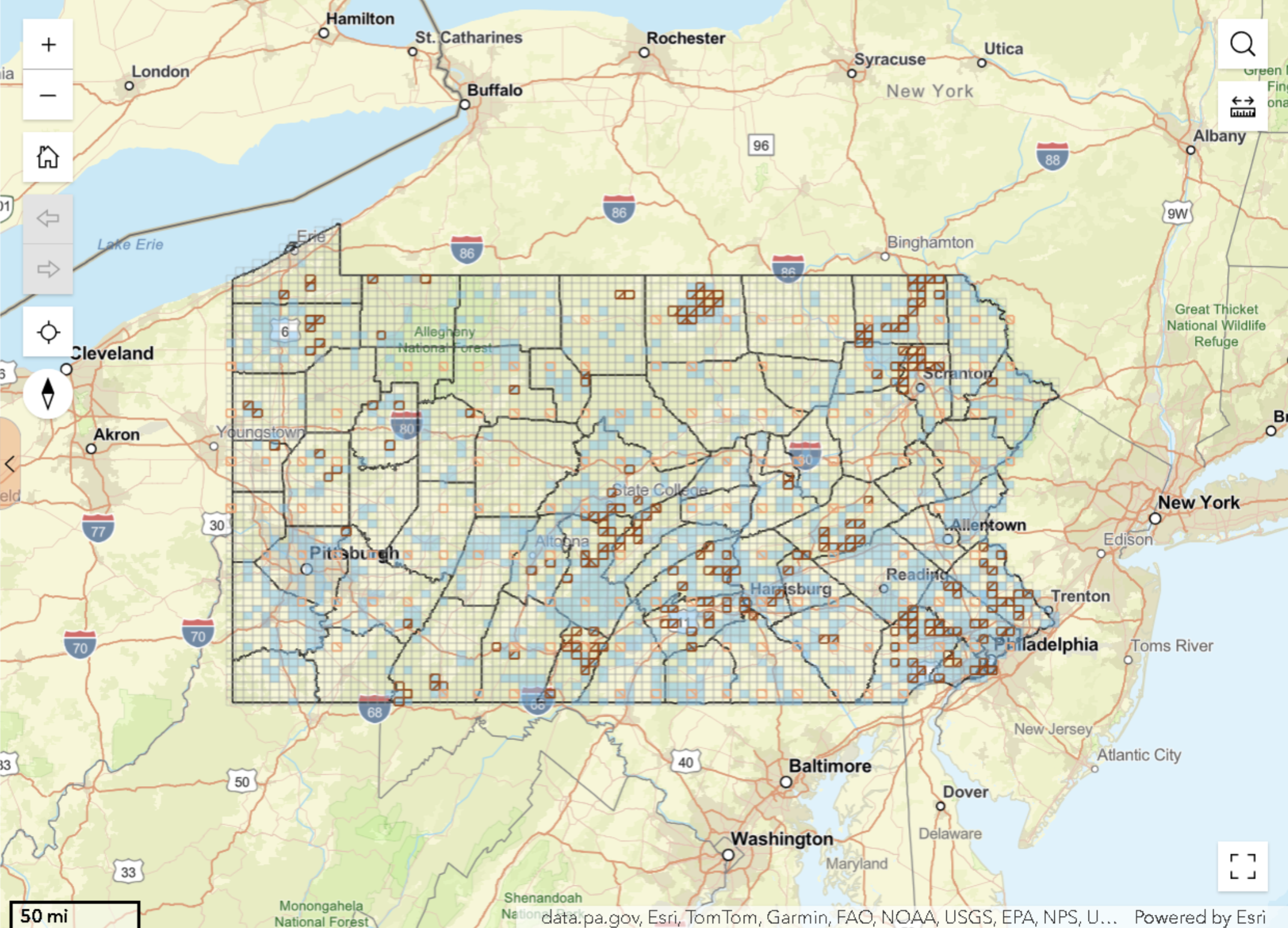
PA Atlas 3×3 Mile Grid
Bucks County has 78 of those blocks. Six are only partial because they are along the Delaware River.
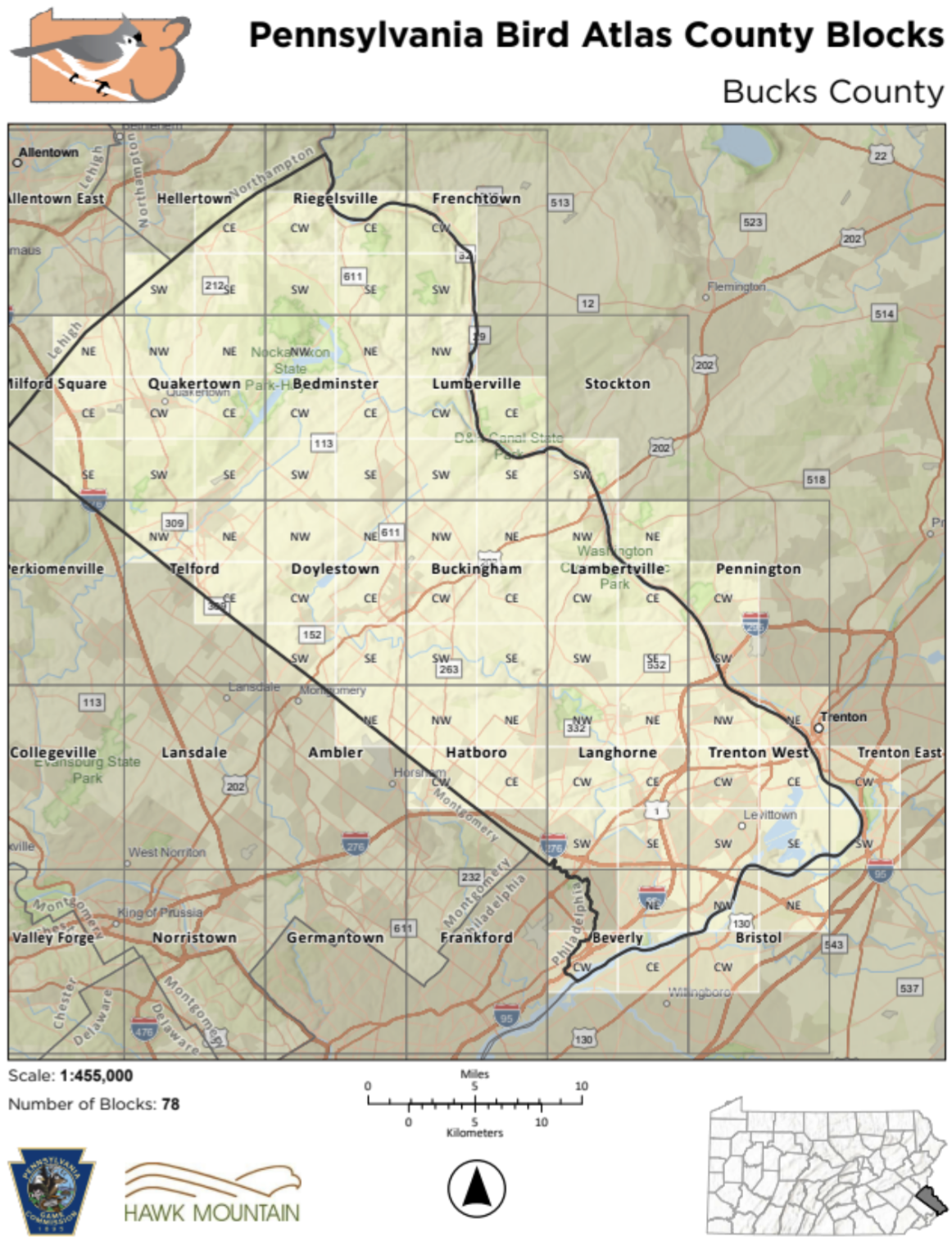
The blocks are in groups of six, two over three, and named after the largest town at the center of the group, sometimes that becomes a New Jersey town like Trenton or Lambertville. The Southeastern most block in the group of six is designated as a priority block as a way to concentrate some effort in under-birded areas but still manage to distribute the effort evenly.
The goal for each block is to give at least 70 different species a breeding code. At least 25 percent of those coded should be confirmed as nesting and no more than 25 percent left coded as “Possible”. Confirmed codes are the easiest to understand. If you see a bird carrying nesting material (CN), sitting on a nest (ON), fledged young hopping around begging for food (FL), carrying an insect in its mouth (CF), carrying a fecal sac (FS), a nest with eggs (NE), or a nest with young (NY), that species is now confirmed for the block. This atlas does not measure how often nesting occurs or the density of nesting in the block. Once a species is confirmed then the focus can move to another species.
This is where the scavenger hunt comes in. If you explore eBird’s Atlas Effort Map with the location set to Bucks County, the map will show dark squares where the block has reached the 70 species goal. The other blocks will be shaded from yellow to green to blue for increasing amounts of birding effort. I like to look at a lighter block and see what habitat is in that block that can be birded. Once I have a location, I check to see what species would be good targets by looking at what has been confirmed already and what species could be upgraded from Possible to Probable or from Probable to Confirmed. I also look for species that have never been coded for the block. Once I have my targets in mind, I head to my location and bird. When you use eBird on the mobile app you can tap the location at the top of the checklist and it will take you to the map. The map will show you if you are close to a block border. Your checklists need to stay within a block. If you see a bird outside the block (say on the NJ side of the Delaware River), you can add it to the list so that your checklist can be complete but you would leave off any breeding codes. If you see a bird outside the block that you are currently birding in and it could be coded, you would submit a separate incidental list with the location set to the proper block. This maintains the spatial accuracy of breeding behaviors.
Don’t forget to bird your yard or your own neighborhood. You may be the only one with access to or knowledge of a nesting bird. Contact us if you would rather not report a sensitive species on private property. We can walk you through the process of keeping the report more obscure. If you enjoy birding near the Peace Valley Nature Center or at Bradford Dam and those blocks have their required 70 or more species, please continue to use the Atlas and code the breeding behavior. You may happen to confirm something that was only marked as possible or probable. Nocturnal lists are helpful as well. The project was aiming to have two hours of nocturnal lists per block but that was becoming too difficult. The requirement is now only for priority blocks. Feel free to submit them for any block if you are able to bird in the night time.
Part of reaching the 70 species goal includes Possible and Probable codes. This is when understanding “safe dates” comes in. The Breeding Guidelines Chart assigns dates to each species as to when that species is migrating, either migrating or breeding, and breeding (safe dates for all codes). Possible codes should only be used in the safe dates for that species. Those codes are Habitat (H) for when the bird is in suitable habitat and Singing (S). These are very general so it is easy to understand why you wouldn't want to code a singing bird in April when it could be migrating to its usual nesting ground. Probable codes can be used in the safe dates and the shoulder time referred to as Either - either migrating or breeding. These codes consist of upgrading your singing bird to singing seven days later (S7), seven or more singing individuals in one block (M), pair in suitable habitat (P), territorial defense (T), courtship, display, or copulation ( C), repeated visits to a probable nest site (N), agitated behavior (A), and Wren/Woodpecker nest building (B) since those species uniquely build or excavate multiple sites. More in depth definitions can be found here. This all sounds a bit confusing but rest assured that mistakes will be cleaned up as the data is processed after each breeding season. Don’t hesitate to use the codes, especially in June and July. As the breeding season ends, the birds start migrating again so the possible codes would drop off first followed by the probable until the only codes you can use are the confirmed codes.
With the arrival of June, Atlasing is at its peak time. Almost every bird can get a breeding code with these exceptions:
In safe dates on June 8: Yellow-billed and Black-billed Cuckoos, Mississippi Kite, Olive-sided, Yellow-bellied, Alder, Willow, and Least Flycatchers, Mourning and Cerulean Warblers, Rose-breasted Grosbeak, American Goldfinch, and Dickcissel.
In safe dates on June 15: Cedar Waxwing.
After the excitement of migration, birding with the goal to code species for the atlas is a calmer, more meditative way of birding. You consider habitats. You lift your binoculars for every bird so that you can see if there is anything in its beak. You learn new details about the birds that you have been enjoying for years. I just recently learned that the Great-creasted Flycatcher is a cavity nester. I never had to think about that before the Atlas. I learned that some species nest earlier (Louisiana Waterthrush and Common Grackle) and others nest later (American Goldfinch and Cedar Waxwing). You notice the agitated behavior of parents that want to distract you and you listen for the soft chattering of young. I really can’t recommend birding for the Atlas enough.
Since you are all fired up and ready to go, start here: https://ebird.org/atlaspa/about/quick-start-guide/ and be sure to join the project on the home page of the Atlas https://ebird.org/atlaspa/home. Once you have joined the project your eBird mobile app will look like this:
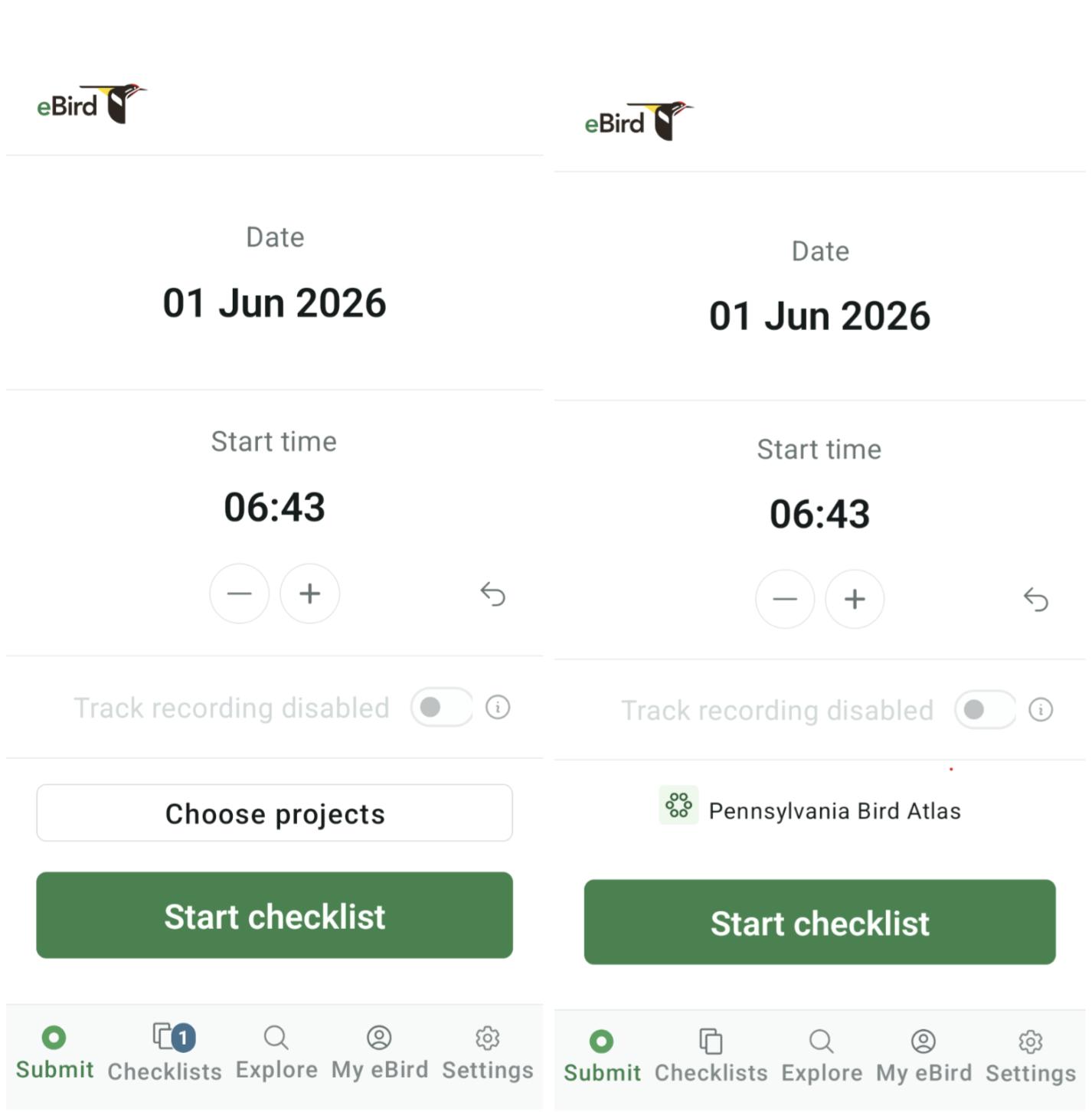
Before and after you choose the Atlas project
That is before and after you choose the Atlas project.
Be sure to toggle it off when you leave PA. Enjoy!
