

My Short Career on the Dead Bird Patrol
Author: Christopher Plummer
Picture: Christopher Plummer
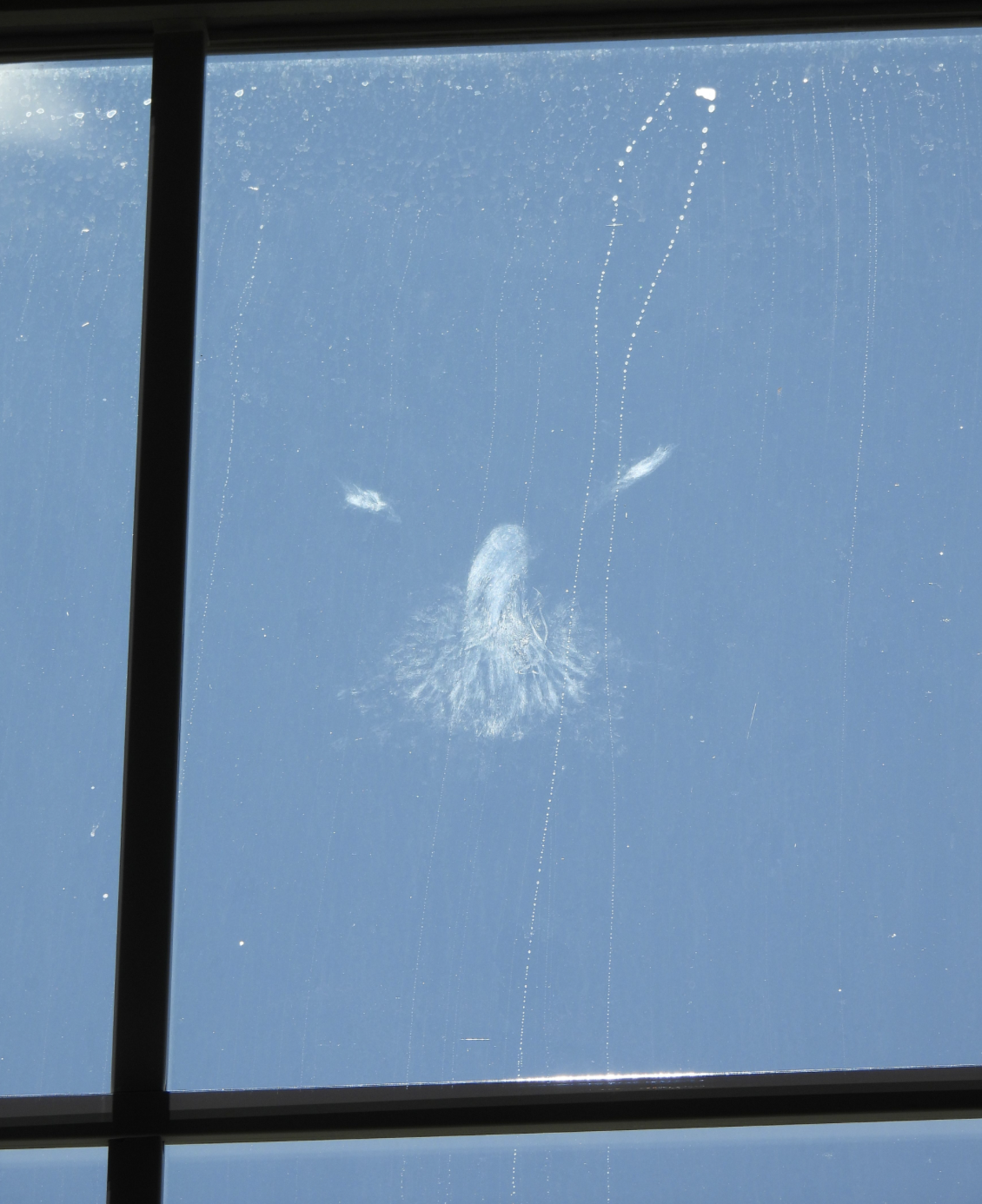
A smudge caused by a bird collision
Have you ever heard the song of a Wood Thrush?
It’s described as “haunting”, “incredible”, and “flute-like”. The remarkable multi-tonal song seems to come from different directions all at once. It’s beautiful, and eerie, words don’t do it justice, and neither do recordings . You must hear it live, and once you have, you’ll never forget it.
It had been a good Spring for me on my “Birdsafe” patrols, with “NO BIRDS” reported on each early Thursday morning trek, poking in the shrubs, glancing in the trees and up at the expansive sheets of highly reflective glass, checking the curbs and street gutters, and scanning the sidewalks around the perimeters of the massive Bucks County Courthouse complex in Doylestown, Pennsylvania for signs of a collision, what we call a “bird strike”. “No Birds” was unusual. It was good, but I always expected at least one.
The first couple of times shuffling around in my backpack alone, I met curious sheriffs and security guards and early commuters. Once we got past introductions, I explained my task, and many times heard the same story: “I’ve been coming in this door every day for five years, and there’s almost always a dead bird, right here,” pointing to a spot on the sidewalk. “Can’t you guys do something about it?”
“Uh, we hope to,” I’d say, slightly embarrassed that “fixing it” was somehow seen as my responsibility. “We’re collecting data.”
This particular volunteer job is odd because it’s full of anticipation – each time I turn a corner, or look down a stairwell, or approach one of the known “kill zones”, I take a breath, prepare to see a smudge of grey feathers and the unsightly, stiff, sometimes twisted remains of a Mourning Dove on the walk. Or as I pick my way down the slope to the loading dock, to see the little black white-pocket-cornered corpse of a Black-Throated Blue warbler, lying among some rubbish—a crumpled handbill or used plastic cup—as if those objects could possibly have held the splendor, the beauty, the incredible promise of the tiny bird that had travelled hundreds of miles, overnight, with the goal of finding a mate and perpetuating its species.
Each discovery of a dead bird threw me into a morass of sadness, anger, and reflection. I concluded that human beings are highly overrated, by themselves mainly. The human Odysseus took ten years to return to his wife in Greece, after ten years of battle in Troy. Those adventures were transmitted originally in oral tradition, then a written narrative for a couple thousand years. Now a movie. That’s what we call an odyssey. Yet these birds, these migrants, with their tiny fragile bodies and small brains, FLY, sometimes thousands of miles, without guides, navigating accurately without physical tools, to and from the same locale, sometimes to precisely the same destination, and do it not once, but twice a year. When they reach their spring destination, where I live, in the Northeast, (usually the males) set up shop in an appropriate location and sing their unique, beautiful songs. Is that their oral tradition? Are they recounting their journey as they sing? All in the hope of attracting a mate.
But then traveling one night, or early one morning, maybe distracted by a light on the fifth floor of an office building, exhausted, hungry, or chased by a predator, looking for water, or a tree, or some clear sky, they SLAM. Into a window they didn’t know was there.
To me each dead bird is tragic. And is it lucky if they break their neck and die immediately? For the volunteer maybe.
The best volunteer day is the one with no birds found. No dead birds at all.
A good day, that’s when you find a stunned or injured bird, you manage to capture and secure it safely in a paper bag to take to people who are skilled at “rehabbing” birds, who will hopefully return the recovered bird to the wild.
A bad day, probably the most common for the volunteer, that’s when we find one or more dead birds. Sometimes still warm. These are logged in a database and bagged, to be sent to Drexel for research.
The absolute worst day, that’s when you find a mortally wounded bird, still breathing, dragging out each gasping breath with its eyes open, struggling to survive, struggling to understand what happened. And what can you do? What can you say? This is a death caused by humans. It’s rampant and most people can’t believe the numbers when they hear them. It is not necessary. Its cause can be remediated. The number of deaths can be reduced in many ways. There are solutions ranging from simple to complex and from inexpensive to very expensive. But the worst is to do nothing.
Holding that warm beautiful Wood Thrush in my gloved hands, I could do nothing. One thin leg dangled where it had been snapped in half. A hole in his soft chest bled where he had been punctured on impact by his own breastbone. He would never establish a territory. He would never find a mate or raise young. He would never again sing his beautiful song.
I sat with him for twenty minutes and I watched him fade. I told him I was sorry. I said goodbye. And then I resigned as a volunteer.
It doesn’t mean that I gave up. I want to share my story and I want to help these birds, but I can no longer bear to watch them die in my hands.
—Christo
Christopher Plummer is a birder and member of the Bucks County Birders, and former volunteer with BirdSafe Doylestown, which is affiliated with Bird Safe Philly.
Great info here:
